Sunday, January 18, 2009

898.3 Special Topics Course

For this term, in my graduate studies at the U of S, I have been approved for a 898.3 Special Topics course titled, Exploring Pedagogicial Strategies for Multi-User Virutal Environments.

This course is designed to examine potential strategies for optimizing instruction within a Multi-User Virtual Environment (MUVE), specifically Second Life (SL). Areas of interest and investigation for this course include:
  • Strategies for designing virtual learning environments (VLEs) in the MUVE, Second Life.
  • General methods of pedagogy used within the MUVE, Second Life.
  • Specific instructional strategies and tools used in the MUVE, Second Life.

The course will be divided into three phases. The first phase will explore the three main areas of interest outlined above and will document instructional strategies currently being used in SL. The second phase will attempt to understand and interpret these findings (methods, strategies) through the lens of instructional theory and design methodology. The third phase will include applying what has been learned in the development of training sessions for the U of S faculty, staff and students in the use of SL.

Sunday, December 21, 2008

Redesign of ECMM Space

The U of S space in Second Life has been successfully subdivided into three parcels. The three parcels include space for the Snellgrove Gallery, ECMM, and general space for the U of S (shown in image below). The purpose of the subdivision is so each parcel can be controlled individually. Media streaming and building permissions are just some of the items that can now be controlled separately for each parcel.

Subdivision of U of S space on Teaching 6 (photo taken December 21/08)

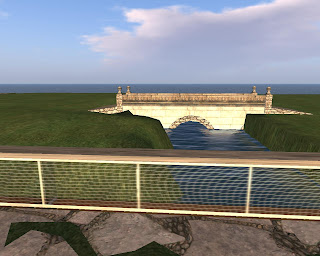
The redesign of the ECMM parcel has begun with the addition of a river, bridge and safety fence (shown in image below). When entering the ECMM parcel from the general U of S parcel you will now walk across a stone bridge over a river. This river is built on the property line separating the ECMM parcel from the general U of S parcel. It would be great if we could come up with a name for the bridge and river!

River, bridge and fence separating ECMM and general U of S parcels (photo taken December 21/08)

For the redesign of the ECMM parcel, we are considering a more open atmosphere design. This means we may not see the resurrection of the ECMM building. However we may incorporate many of the spaces including meeting area, teaching and learning area and multimedia area into a more open area design.

To redesign this space we are are going to take more of a structured design approach. We will first complete a front end analysis of the space including a needs assessment, potential educational activities, and potential learners. The next stage of development will include a design strategy resulting in a blue print, identifying a design plan. We understand the needs of this space will change, however we are interested in coming up with a base or starting point flexible enough to be manipulated to meet a variety of needs.

Wednesday, September 10, 2008

Session 7: Promoting Interactivity

The objectives for session 7 were to:
  • Identify builidng projects that support interactivity in learning.
  • Associate capabilities of interactivity builds with appropriate pedagogical objectives.

To begin the class Mali Young started a camp fire and asked us to change our environment to midnight. This was done to provide atmosphere and to set a mood, and it actually worked. Mali expressed that building and creating a mood helps to motivate learners. We were also told that including aspects of playfulness are important in motivating learners.

One of the basic, fun ways to incorporate interactivity in SL is to make a live survey. Questions can be asked through powerpoint slides or textures applied to a media screen or prim. Participants can have different colored cards that they wear to provide their answers. We participated in a live survey, and to begin a large media screen was rezzed to view the powerpoint survey questions. Each student then clicked a prim (box) to receive the colored cards used to identify their answers. Questions were then provided to us on the screen and we presented our answers by wearing colored cards. This type of activity is useful for live formative assessment and is known to build cohesiveness within a group.

Another useful tool designed for interactivity is a suggestion box, also known as a feedback box, hand-in box, or survey collector. These tools allow for information to be collected for purposes such as quizzes, surveys, homework or any other type of information needed to be collected. Surveys can also be done through web-based survey tools like Survey Monkey. To do this the survey URL giver is put into a prim with the URL of the survey. When the prim is clicked it provides an option to load the survey in an external web-browser.

Walk through tutorials are another way to incorporate interactivity. A great example of a walk through tutorial is The Particle Laboratory http://slurl.com/secondlife/Teal/180/70/21. It is designed to take you through a step by step process of adding particle textures to prims. ED Tech Island http://slurl.com/secondlife/EdTech/214/56/26 was originally setup to study social persistence in a SIM. Some of the Island's research focuses on how to promote or keep individuals on a SIM. Design methods such as creating pathways, putting information along pathways, creating community groups and sending out group notices have been used to control traffic on the SIM. A fantastic example of a walk through tutorial is Thursday' Fiction http://slurl.com/secondlife/Esperance/239/41/22/?title=Thursday%27s%20Fiction, based on a movie and book of the same title. It is still under construction but what has been created is an amazing experience, although disturbing at times.